Your website is the hardest-working member of your team. It never sleeps, never takes a holiday, and greets every potential customer who finds you online. Yet most business owners can tell you the last time they serviced their car, but not the last time anyone properly checked their website.
A website audit is that check. It is a systematic, honest examination of how your site is performing — not just how it looks, but how fast it loads, how it behaves on a phone, whether Google can find it, whether visitors trust it, and whether it turns any of them into enquiries. In 2026, when customers research everything online before they pick up the phone, running your business on an unchecked website is like running your shop with the lights off.
Here is what a website audit actually is, what it checks, and why every business — from a one-person trade to a growing company — needs one.
What is a website audit?
A website audit is a structured health check for your site. Instead of guessing why the phone is quiet or why visitors leave without enquiring, an audit measures what is really happening: page by page, across speed, mobile experience, search visibility, content, security, design and conversions.
It is worth saying what an audit is not. It is not a quick glance at your homepage and a verdict of “looks fine”. It is not a scare tactic designed to sell you a rebuild. A proper audit is evidence-based: it runs real tests, lists real problems, and — crucially — prioritises them, so you know which fixes will make the biggest difference and which can wait.

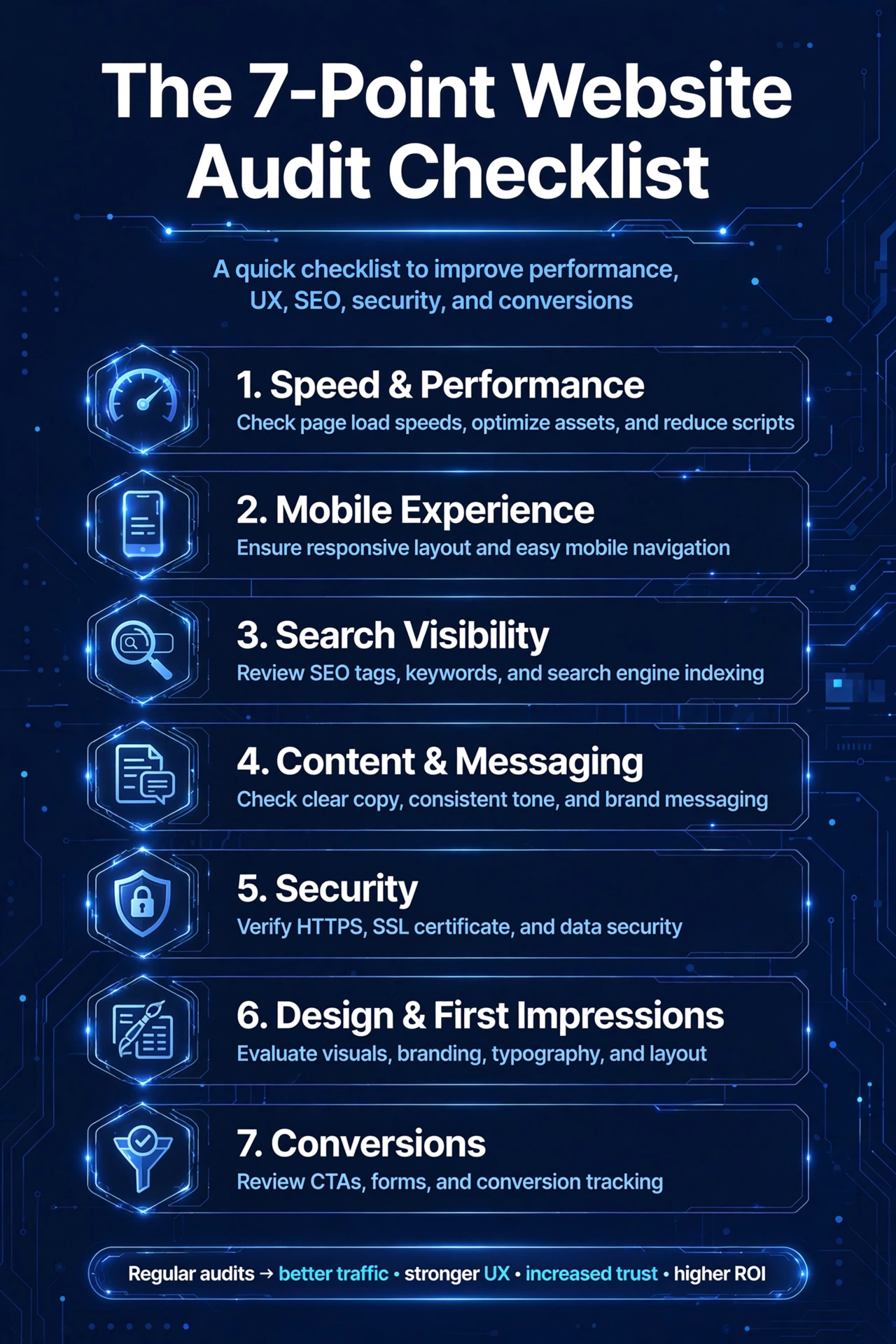
The 7 things a proper website audit checks
1. Speed and performance
Nobody waits for a slow website. Visitors on a phone, on a train, on patchy wifi — which describes a large share of your traffic — will simply leave if your pages drag. An audit measures how long your pages actually take to load on real devices and connections, and finds what is slowing them down: oversized images, too many plugins, cheap hosting, or code that was fine five years ago and is not fine now.
Speed is not just about patience. Google uses page experience as a ranking signal, so a slow site is also a less visible site.
2. Mobile experience
Most of your visitors are on a phone. An audit checks your site the way they see it: Are buttons big enough to tap? Is the text readable without pinching and zooming? Does the menu work? Is the enquiry form usable on a small screen? A site that was designed on a desktop and never properly tested on mobile is quietly turning away the majority of its visitors.
3. Search visibility (SEO)
If Google cannot find, understand or trust your pages, customers cannot either. An SEO audit checks the technical foundations — whether your pages are indexed, whether titles and descriptions say what they should, whether headings are structured properly, whether images have alt text, and whether broken links or duplicate content are undermining you. It also looks at the basics Google expects every business site to get right: a sitemap, secure HTTPS, and a Google Business Profile that matches your site.
You do not need to become an SEO expert. But you do need to know whether your site has the foundations in place, because everything else you do to get found builds on them.
4. Content and messaging
This is the part most audits skip and most websites fail. An audit reads your site the way a first-time visitor does and asks hard questions: Does the homepage say what you do within five seconds? Is it obvious who you serve? Does the copy answer the questions customers actually ask — how much, how long, do you cover my area? Is the content thin, outdated, or full of jargon?
Outdated content quietly damages trust. A “latest news” section that stops in 2023, or service pages describing things you no longer offer — all of it tells a visitor the same thing: nobody is minding this shop.
5. Security
A hacked or insecure website does not just embarrass you — it actively drives customers away. Browsers now warn visitors loudly when a site is not secure, and a single “not secure” warning next to your address bar can end a visit before it starts. An audit checks that your site runs over HTTPS with a valid certificate, that software and plugins are up to date, and that there are no known vulnerabilities or malware warnings attached to your domain.
For any business that takes enquiries or payments online, this is non-negotiable.
6. Design and first impressions
Visitors judge your business by your website in seconds, and they compare it — consciously or not — with your competitors’. An audit looks at your site with fresh eyes: does it look current or a decade old? Is the branding consistent? Are images sharp or pixelated? Does the layout guide the eye, or does everything compete for attention?
This is not about fashion. It is about credibility. A dated, cluttered site tells a visitor your business might be dated and cluttered too — whether or not that is true.
7. Conversions: turning visitors into enquiries
This is the check that matters most, and the one almost nobody does. Traffic is vanity; enquiries are sanity. An audit follows the path a visitor takes and asks: Is there a clear call to action on every page? Does the contact form ask for the minimum, or does it interrogate people? Is your phone number visible on mobile? What happens after someone submits the form — do they get a confirmation, a timeframe, a human response?
Many businesses spend money driving traffic to a website that was never set up to convert it. An audit finds the leaks in that bucket before you pour more water in.
The warning signs your website needs an audit now
You do not need to wait for a scheduled review if any of these sound familiar:
Enquiries have dropped but you cannot point to why.
The site is slow, especially on your own phone.
It looks dated next to competitors — you feel slightly embarrassed sending people to it.
You have changed the business (new services, new prices, new area) but the site still describes the old one.
You are spending on marketing — ads, social, flyers — and the website is where all of it lands.
Customers keep asking questions the website should answer — opening hours, prices, whether you cover their area.
You have never had one. If no one has ever audited the site since it launched, it needs one. Full stop.
Any one of these is reason enough. Two or more, and the audit is overdue.

Free tools vs a professional audit
You can — and should — run some checks yourself. Google’s PageSpeed Insights will grade your speed for free. Google Search Console (also free) will tell you whether Google can crawl your site and flag the obvious errors. Browsing your own site on your phone, honestly, as a customer would, is more revealing than most owners expect.
But free tools have limits. They report symptoms, not causes. They will tell you a page is slow without telling you which of the fourteen things slowing it down to fix first. They will flag SEO issues without telling you which ones are costing you customers and which are noise. And they will never tell you that your messaging is confusing, your offer is unclear, or your call to action is invisible — because those are judgement calls, and judgement is what a professional audit adds.
The honest answer: start with the free checks, but get a professional audit at least once — it gives you the prioritised list that turns “our website needs work” into an actual plan.
How often should you audit your website?
For most small businesses, a full audit once a year is the right rhythm — and a lighter check every quarter. Audit sooner if you redesign the site, change what you sell, notice a drop in enquiries, or start spending seriously on marketing. A website is not a brochure you print once; it is a living asset, and it needs the same periodic attention as everything else in the business.
What happens after the audit
An audit is only useful if it leads to action. A good audit report does three things: it lists every issue found, it ranks them by impact (what is costing you customers versus what is merely untidy), and it gives you a clear order of work.
Some fixes are quick — updating content, compressing images, fixing broken links. Others are structural — a slow theme, a confusing layout, a site that was never built to convert. Knowing which is which is the whole point: it stops you spending money on the wrong things.
At Altus, every project starts from this kind of honest assessment. We scope work to a firm fixed price once we understand your project — no hourly meters running, no surprises — across four levels depending on what your business actually needs, from essential fixes to a full rebuild. The audit tells us which level fits, so you never pay for more than the problem requires.
Frequently asked questions
How long does a website audit take?
A thorough audit of a typical small-business site takes a few days of proper work — running the tests, reading the site as a customer would, and writing up prioritised findings. Anyone promising a complete audit in ten minutes is running an automated scan, not an audit.
How much does a website audit cost?
It varies. Many agencies, including Altus, offer a free initial audit — a genuine health check, not a sales call in disguise — because it is the fastest way to show you what is actually wrong. Deeper technical audits are usually quoted as a fixed price once the size of the site is understood.
Can I audit my own website?
You can make a start: check your speed with free tools, browse the site on your phone, and read every page as a first-time visitor. What you cannot easily do is see your own blind spots — the confusing navigation you have learned to live with, the jargon you no longer notice, the technical issues buried under the surface. That is what an outside pair of eyes is for.
Will an audit hurt my search rankings?
No — an audit changes nothing on your site. It only reports. The fixes that follow an audit are what improve rankings, and a good audit prioritises the safe, high-impact ones first.
Get your free website audit
Your website might be fine. But “might be” is an expensive way to run a business. A free 15-minute audit will tell you exactly where your site stands — what is working, what is costing you enquiries, and what to fix first.
Book your free 15-minute website audit — no obligation, no jargon, just an honest answer about your website.