Most website projects don’t go wrong because of bad design. They go wrong because of a bad brief — or no brief at all.
If you walk into your first call with a web designer and say “I need a website, something modern, how much?”, you’re handing them a blank sheet and asking them to read your mind. What you get back will be a guess. Sometimes it’s a lucky guess. Usually it’s an expensive one.
The good news: a proper brief doesn’t take long to prepare, and it pays for itself many times over. It gets you an accurate quote, a design that actually fits your business, and a project that finishes on time. Here’s exactly what to prepare before you pick up the phone.
1. Start with your goals — not your favourite colours
The single most important line in any brief is the answer to this question: what do you want the website to do for your business?
“Look professional” isn’t a goal. “Get more enquiries from local customers” is a goal. “Take online bookings so I stop playing phone tag” is a goal. “Sell my products online without me managing stock emails” is a goal.
A designer who knows your goal makes different decisions about everything — the layout, the buttons, the pages, even the words. Write down your one main goal, plus one or two secondary ones. If you genuinely don’t know, say so on the call; a good designer will help you work it out. But arriving with even a rough answer puts you miles ahead.
2. Describe your customers
Who is the website actually for? “Everyone” is the wrong answer — a website for everyone ends up speaking to no one.
Think about your best customers. Are they mostly local, or do they come from all over? Are they price-sensitive or quality-focused? Are they browsing on their phones at 10pm, or sitting at an office desk?
Jot down a short profile: who they are, what they worry about, and what would make them pick you over a competitor. This tells the designer how the site should look, what tone the words should take, and which pages matter most.
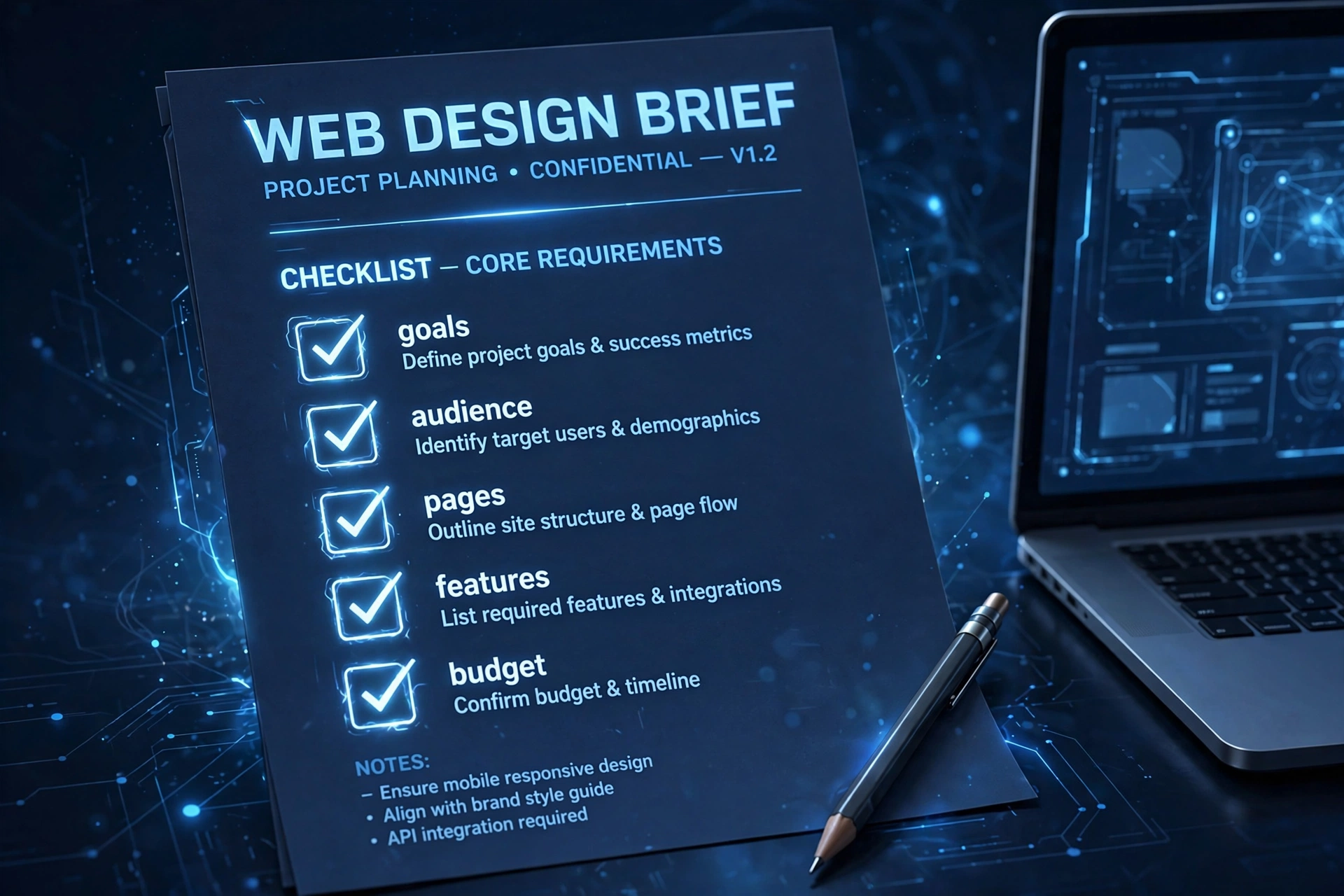
3. Collect examples — of what you like AND what you don’t
This is the fastest way to get aligned on style. Browse the websites of businesses you admire — they don’t have to be in your industry. When you find one you like, note down what you like about it: the clean layout, the big photos, the way the booking button is always visible.
Equally useful: examples of sites that put you off, with one line on why. “This one feels cluttered.” “This one’s text is too small to read on my phone.” This saves enormous amounts of back-and-forth later, because “modern” means something different to every person on earth.
Aim for three to five likes and two or three dislikes. Links are enough — you don’t need screenshots.
4. List the pages and features you need
You don’t need a full sitemap, but a rough page list helps the designer quote accurately — and stops the “oh, we also need a shop” moment halfway through the build.
A typical small-business site might need:
- Home — the front door, with a clear headline and call to action
- About — who you are and why customers should trust you
- Services — what you offer, ideally one page per service
- Testimonials or reviews — proof you do good work
- Contact — with a simple form, your phone number and opening hours
- Blog or news — optional, but great for search engines
Then the features: do you need online booking? A contact form that goes to your email? A photo gallery? A shop with checkout? An FAQ section? A map? List everything you can think of, even if you’re unsure — the designer can tell you what’s sensible and what’s overkill.
5. Sort out your content and photos — early
This is where most projects stall. The design gets finished, and then everyone waits three weeks for the “about us” paragraph and decent photos.
You don’t need final copy before the first call, but know who will write it: you, or the designer (many offer copywriting as an add-on). And be honest about your photos. If all you have are dim phone pictures from 2019, say so — the designer can plan around it, suggest a photographer, or use well-chosen stock imagery.
The rule of thumb: if the website launches in March, your words and pictures need to be ready in February, not “sometime soon”.

6. Set a budget — and say it out loud
Nobody likes talking about money first, but your budget is the single biggest factor in what the designer recommends. A £500 site, a £2,500 site and a £10,000 site are three completely different projects, and guessing which one you want wastes everyone’s time.
You don’t need to know what websites cost — that’s the designer’s job to tell you. What helps is a range: “we’re hoping to spend around X” or “we absolutely can’t go above Y”. A trustworthy designer will tell you honestly what your budget buys, and what it doesn’t.
Our approach at Altus is a firm fixed price once we understand your project — no hourly billing surprises, no creeping costs. We work in levels, from a solid starter site up to fully custom builds with AI features like chat and booking automation. Knowing your budget lets us put you in the right level from day one.
7. Agree on how you’ll work together
Before the project starts, get clear answers to a few practical questions:
- How long will it take? A typical small-business site takes a few weeks; anything much longer or much shorter deserves an explanation.
- How do I give feedback? One round of changes or unlimited tweaks? Clarity here prevents painful arguments later.
- Who is my contact? One named person beats a faceless support queue.
- What happens after launch? Who updates the site, fixes things, and keeps it secure? Ask about maintenance upfront — a website isn’t a one-off purchase, it’s a living thing.
Write down the answers. A short email summary after the call is worth its weight in gold.
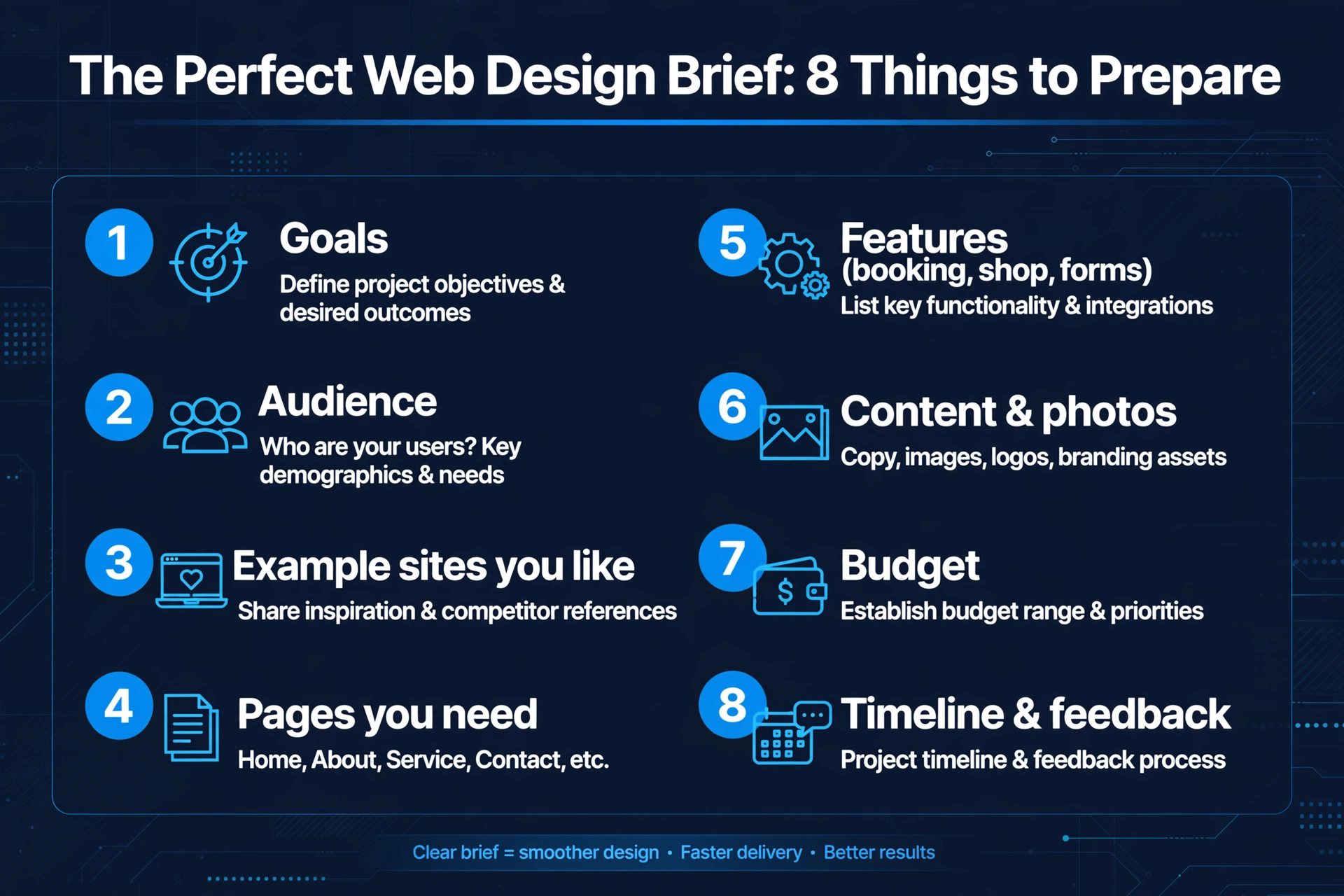
8. The thing most people forget: access and logins
On launch day, nothing is more frustrating than discovering nobody knows who owns the domain name. Before the project starts, track down:
- Your domain name login (the company you bought it from — e.g. GoDaddy, 123 Reg, Namecheap)
- Access to your current hosting, if you have a site already
- Any existing email or booking systems the site needs to connect to
If you’ve lost them, recover them now — it can take days, and it always happens at the worst moment.
What a good designer will ask YOU
Pay attention to the questions on that first call. A good designer asks about your business, your customers, and your goals. They ask what’s worked and what hasn’t. They may challenge your assumptions — that’s a good sign.
Be cautious if the conversation jumps straight to colours, fonts and prices without a word about your business. A website is a business tool first and a design object second. Anyone who skips the business part is decorating, not designing.
Red flags to watch for
- No questions about your goals. See above.
- A quote with no breakdown. You should know what you’re paying for.
- “Unlimited everything” promises. Usually means nothing is actually defined.
- No contract or terms. Even a one-page agreement protects both sides.
- Pressure to decide today. A good designer is busy enough not to need that.
Frequently asked questions
Do I need a written brief, or is a chat enough? A chat is a fine start, but get the key points in writing afterwards — goals, pages, budget, timeline. Memory is unreliable; email isn’t.
What if I don’t know what I want? That’s completely normal, and honestly telling the designer is far better than pretending. A good designer will guide you — but “I don’t know yet” is a starting point, not a brief.
How detailed should the brief be? One to two pages is plenty for most small businesses. Enough to be clear, short enough that someone actually reads it.
Should I get multiple quotes? Yes — two or three. Compare them on what they include and how well the designer understood your goals, not just the price. The cheapest quote for the wrong website is the most expensive option.
Ready to brief us?
If you’ve worked through the list above, you’re already ahead of most people who pick up the phone. And if you haven’t — no problem. Book a free 15-minute consultation and we’ll walk through it together, no jargon, no obligation.
Book your free website consultation — we’ll audit your current site (or your plans for a new one) and give you honest advice on the right next step.