Your domain name is your address on the internet. It is the thing customers type to find you, the thing printed on your van, and the thing that sits in every email you send. Get it right and nobody ever thinks about it. Get it wrong and you will be explaining your spelling for years.
This guide walks you through what a domain name actually is, why it matters more than most business owners realise, and the seven rules we use at Altus Web Solutions when we help clients choose theirs.
What is a domain name?
A domain name has two parts: the name itself (like altuswebsolutions) and the extension (like .com or .co.uk). Together they form the web address people type into a browser. Behind the scenes, the domain points to a server where your website lives — think of it as a signpost that turns a string of numbers into something humans can remember.
You do not buy a domain outright. You register it, usually for one to ten years at a time, and you pay a small yearly fee to keep it. Miss the renewal and someone else can grab it.
Why your domain name matters
Three reasons. First, trust. Customers judge a business by its web address. A clean, professional domain says you are established; a long, hyphenated one raises eyebrows. Second, branding. Your domain travels everywhere — business cards, invoices, social bios, word of mouth. It should sound like you. Third, findability. A clear name that matches your business makes you easier to remember and easier to find again.
The 7 rules of choosing a great domain name
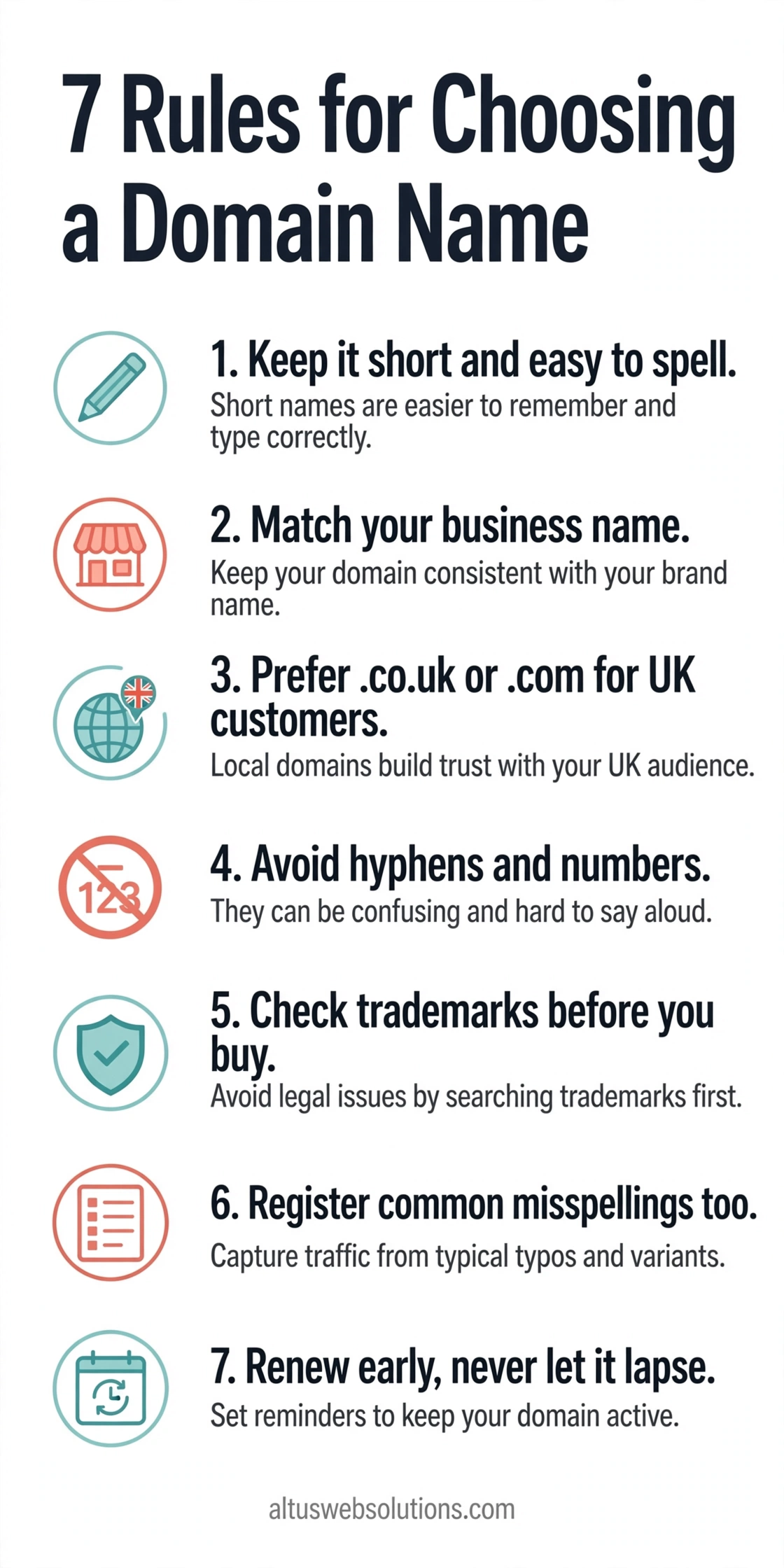
Keep it short and easy to spell
The best domains are short — ideally under 15 characters before the extension. If you have to spell it out letter by letter on the phone, it is too complicated. Short names are easier to remember, easier to type, and harder to get wrong.
Match your business name
Your domain should be your business name, or as close to it as registration allows. Consistency builds recognition: the name on your van, your invoices and your website should all agree with each other.
Prefer .co.uk or .com for UK customers
A .co.uk tells British customers you are local. A .com works everywhere and is the most remembered extension on earth. If you can, own both and point them at the same website.
Avoid hyphens and numbers
Hyphens are forgotten, numbers are misheard (“is that the number 4 or the word four?”). Both make your address harder to share by voice — and most referrals happen by voice.
Pass the radio test
Say it out loud as if you were telling a friend over a noisy phone line. If they could type it correctly on the first try, you are in good shape. If not, simplify.
Check trademarks before you buy
A name that clashes with an existing brand can cost you far more than a domain ever will. A quick search of the UK Intellectual Property Office database takes minutes and can save you a painful dispute.
Think long term
Choose a name that still fits in five years. Avoid tying yourself to one service or one town if you plan to grow beyond them — rebrands are expensive.
.co.uk vs .com vs .uk — which should a UK business choose?
For most UK small businesses, the answer is simple: secure your name on .co.uk first. It signals you are a British business and British customers instinctively trust it. The shorter .uk is the modern alternative and pairs nicely — many businesses own both and point them at the same site.
The .com is the global default. If you ever plan to sell outside the UK, or if your perfect .co.uk is taken, .com is the safe choice. Newer extensions like .shop or .london can work as a supporting act, but never build your main brand on one — customers default to typing .co.uk or .com from memory.
Register the common misspellings and the obvious variants of your name too, and point them all at your main site. It costs little and stops competitors — or typosquatters — from catching your lost traffic.
Common domain mistakes (and how to avoid them)
best-cheap-plumbers-london-247.co.uk looks spammy and is impossible to say out loud. Your brand name beats a bag of keywords.
The most expensive mistake on this list. Set auto-renew and keep your contact email current — lapsed domains get snapped up fast.
Make sure the domain is registered to you or your company, not your web designer or a former employee. Ownership disputes are painful.
Loving a name is not the same as being allowed to use it. Search the IPO database before you commit.
Use a reputable, Nominet-accredited registrar for .uk domains so support and transfers are straightforward when you need them.
A name tied to one service or one town boxes you in. Pick something your business can grow into.
How to register your domain
Search for your name
Use a reputable registrar’s search tool to check whether your chosen name is available on the extensions you want.
Pick your extensions
At minimum, your name on .co.uk. Ideally .com as well, plus any misspellings worth protecting.
Add privacy protection
If offered, switch it on so your personal details are not published in the public WHOIS record.
Register for more than one year
Turn on auto-renewal from day one. A lapsed domain is the easiest way to lose a brand you have spent years building.
Point it at your website
Your web designer or host will connect the domain to your site with DNS records — usually a five-minute job.
Frequently asked questions
Does my domain name affect my Google rankings?
Only a little, and only indirectly. Keywords in domains carry very little weight. What matters is that people remember your name, trust it, and click on it — that behaviour helps.
How much does a domain name cost?
A standard .co.uk or .com costs a small yearly fee — roughly the price of a couple of coffees. Premium names sold on the aftermarket can cost far more, but most businesses never need one.
What if the name I want is already taken?
Try a small variation: add your town, your trade, or switch extensions. Never copy a competitor’s name with a tweak — that is how trademark disputes start.
Can I change my domain name later?
Yes, but it is disruptive — redirects, updated listings, reprinted materials. It is far cheaper to choose well the first time.
Who actually owns my domain?
Whoever is named as the registrant. Check this today if someone else registered it for you — ownership should sit with you or your limited company.
Ready to get your online address sorted?
Choosing a domain is step one — what it points to matters just as much. Book a free 15-minute website audit and we will map out exactly what your business needs, starting with the name on the door.