Your school’s website is one of the first things Ofsted inspectors look at — and the first thing most parents read. But the Department for Education doesn’t just suggest what should be on it; it sets out specific information every school in England must publish online, and missing items are one of the most common flags in inspections. Here is the complete 2026 checklist, organised so you can audit your site in an afternoon.
Why compliance matters more than most schools realise
Three audiences read your website before they ever set foot on your premises. Parents use it to choose a school and to judge how seriously you take communication. Prospective staff read it to decide whether to apply. And Ofsted inspectors check published information as part of their preparation — a website missing required policies or an out-of-date pupil premium strategy tells its own story before the visit begins.
There is a practical point too. Academies and colleges must provide a paper copy of published information free of charge when a parent asks. If it’s not on the website, the request lands on your office desk instead.
School website compliance is not about pretty design — though that helps. It is about having the right information, in the right place, up to date. Below is every category the DfE expects, followed by the new 2026 additions and a yearly deadline calendar you can hand to your office manager.
The complete 2026 school website checklist
Postal address, phone number, named contact for queries, the headteacher’s name, the chair of governors, and your SENCO’s contact details in the SEN report.
Arrangements published by 15 March (with your PAN), in-year application details by 31 August, and the admission appeals timetable by 28 February.
Behaviour policy with anti-bullying strategy, complaints procedure, charging and remissions policies, and the safeguarding and child protection policy.
Subject content for each academic year, relationships/RSE policy, RE details and withdrawal rights, KS1 phonics schemes, KS4 courses — and your music development plan.
Your latest Ofsted report or a clear link to it, exam and assessment results, and a link to the DfE performance tables.
An annually reviewed SEN information report covering statutory SEN details, disabled pupils’ admissions, less-favourable-treatment steps, and your accessibility plan.
Pupil premium strategy by 31 December on the DfE template; PE and sport premium report by 31 July with spending, impact, sustainability and Year 6 swimming figures.
Equality objectives refreshed at least every four years, plus an annual statement of compliance with the public sector equality duty.
Provider access policy statement, your careers lead’s name and contact details, a programme summary, how impact is measured, and the next review date.
Official school opening hours, the school uniform policy, and your remote education provision — all easy to overlook, all expected online.
Academy trusts: the extra layer
If your school sits in an academy trust, there is a second layer of requirements. Trusts must publish their audited annual report and accounts by 31 January each year, plus governance documents: the memorandum and articles of association, the names of members and trustees, their business and financial interests, the funding agreement, and up-to-date governance arrangements.
Financial transparency keeps tightening. Trusts must publish how many staff earned over £100,000 in £10,000 bands — and new for 2026/27 under the Academy Trust Handbook 2026, multi-academy trusts must publish an annual summary by 31 January explaining how funding is distributed across their schools. Trusts must also publish their whistleblowing procedure.

New for 2026: three additions to check
Compliance is not standing still. Three recent developments belong on every school’s radar.
Linked to the DfE’s Inclusive Mainstream Fund, every mainstream school receiving the fund must publish an Inclusion Strategy on its website by 31 December 2026 — approved by governors or trustees and reviewed annually. This is a whole-school strategy, not a SEND add-on, and the deadline is closer than it looks.
Following the July 2026 statutory guidance on allergy safety in schools, schools in scope must have a dedicated allergy safety policy — separate from the wider medical conditions policy — published on the website, naming a senior leader responsible and reviewed at least annually.
The DfE’s overhauled school food standards, published in September 2026, expect schools to publish their menus and school food policies online, with most requirements taking effect in September 2027. Forward-thinking schools are publishing now rather than scrambling next summer.
The yearly deadline calendar
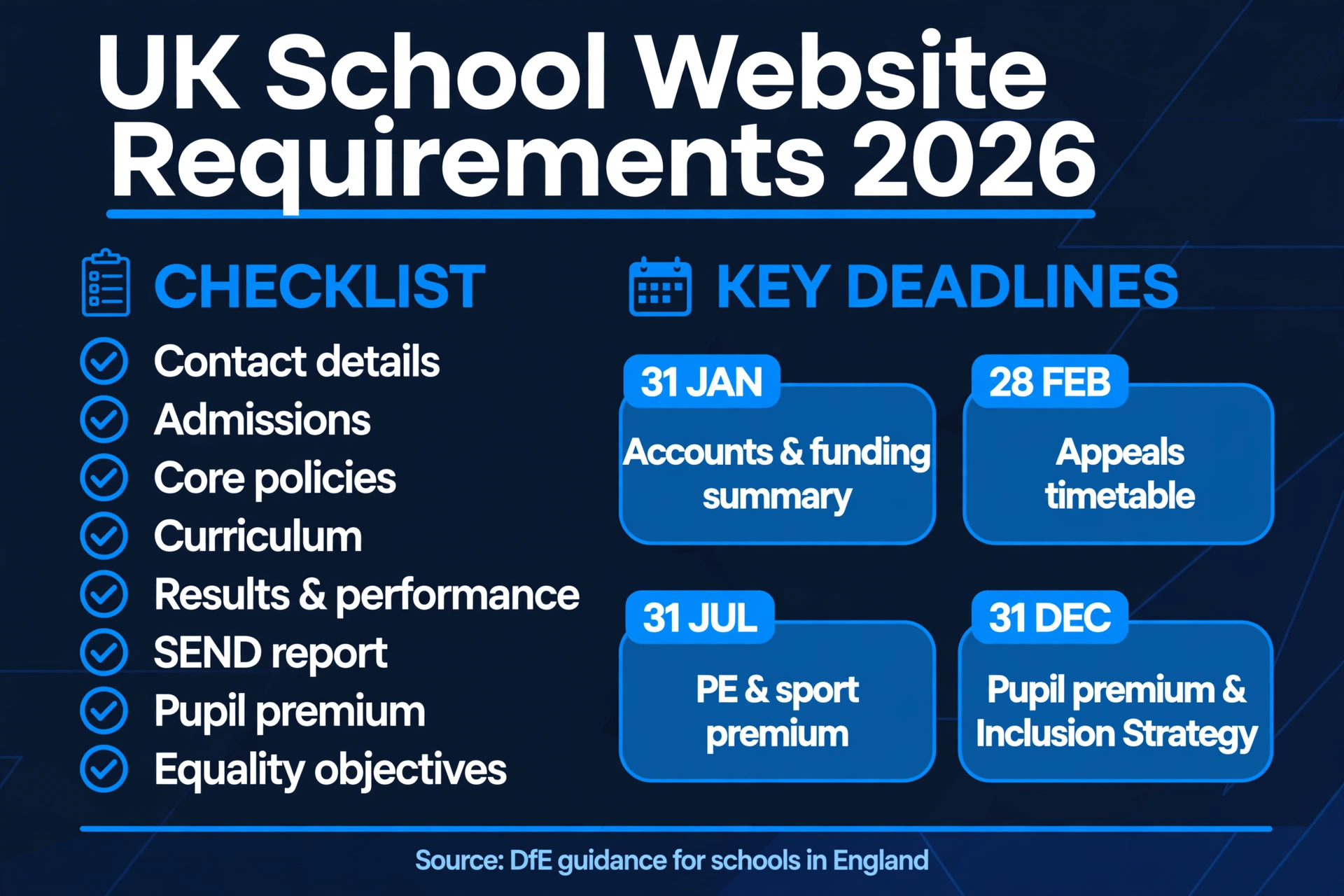
31 January — accounts and funding transparency
Academy trusts publish audited annual report and accounts. Multi-academy trusts add the new annual funding distribution summary from 2026/27.
28 February — admission appeals timetable
Publish how appeals will be organised and heard, giving parents at least 20 school days to lodge an appeal after an unsuccessful application.
31 July — PE and sport premium
Primary schools publish funding received, the full spending breakdown, impact on pupils’ activity, sustainability plans — and Year 6 swimming attainment.
31 December — pupil premium and inclusion
Pupil premium strategy statement on the DfE template. New for 2026: the Inclusion Strategy for schools receiving the Inclusive Mainstream Fund.
Put these four dates in the office calendar with reminders six weeks ahead, and half your compliance risk disappears.

The 15-minute self-check
You do not need a consultant to find the gaps. Work through this once a term.
- Open your site as a stranger would. Can a parent find contact details, admissions and the complaints procedure within two clicks of the homepage?
- Check the dates. Open every policy document and look at its review date. Anything older than a year is suspect; pupil premium and PE premium documents must match this year’s deadlines.
- Search your own site for the word “draft”. Draft policies, placeholder pages and “coming soon” notices have a habit of surviving for years.
- Click every PDF. Broken links and corrupted scans are embarrassingly common — and they count as unpublished information.
- Ask one parent to find something. Pick the SEN information report or the uniform policy. If they can’t find it in a minute, neither can an inspector.
Frequently asked questions
Do independent schools have the same requirements?
No. The DfE publication guidance applies to maintained schools, academies, free schools and FE colleges in England. Independent schools follow the Independent School Standards instead, though many publish similar information as good practice.
What happens if our website is missing required information?
Ofsted inspectors check published information when preparing for and conducting inspections. Gaps don’t automatically fail a school, but they raise questions about leadership and governance — and they are among the easiest issues for inspectors to evidence.
Can policies be PDFs, or do they need to be web pages?
Either is acceptable, but PDFs must open, be readable on a phone, and carry a current review date. A policy that exists only as a broken link is the same as no policy at all.
How often should we review the whole site?
At least termly — and immediately after any DfE guidance change. The 2026 additions above are a reminder that the list grows; a site that was compliant in 2024 may not be compliant now.
Most schools we speak to discover three or four gaps on their first read-through. Altus Web Solutions built a free school website compliance checker that audits a school site against the DfE checklist in seconds. Run your school’s site through it, fix what it flags, and this article becomes a to-do list you can finish in a weekend.
Is your school website actually compliant?
Book a free 15-minute website audit — we’ll check your site against the 2026 DfE requirements and show you exactly what’s missing.