A customer stands in their kitchen and asks their phone, “Where’s the best web design company near me?” A smart speaker answers with a single name. An AI chatbot drafts an answer and links to two websites. No one typed anything. No one scrolled through ten blue links.
That is how more and more customers find businesses in 2026 — through voice assistants and AI-powered search. The question for your business is simple: when an AI assistant answers your customer’s question, is it quoting your website or your competitor’s?
This guide explains what’s actually changing, and the six practical things you can do about it.
How people really use voice search
Typed searches are short: “web design london”. Voice searches are sentences: “Who’s the best web design company in London for small businesses?” People talk to their devices the way they’d talk to a person — full questions, with words like who, what, where, when and how.
That difference matters because most business websites are written for typed searches. They target short keyphrases and expect visitors to do the reading. Voice search flips it around: the device does the reading, and it reads from one source — the page it trusts most to answer the question directly.
So the websites winning voice searches have one thing in common: they answer questions clearly, in natural language, near the top of the page.

Why AI search changes the rules even more
Voice assistants were the warm-up. The bigger shift is AI search: instead of a list of links, search engines and chatbots now give a single summarised answer, built from a handful of trusted sources. If your website isn’t one of those sources, you never appear — not even as a link.
Here’s the uncomfortable part: AI answers are trained on content that’s clear, structured and easy to quote. Vague marketing copy gets skipped. “We deliver cutting-edge digital solutions” means nothing to an AI — and increasingly, nothing to customers either. Pages that state plain facts, in plain sentences, get cited.
The good news? You don’t need new technology to fix this. You need clearer content. And that’s entirely within your control.

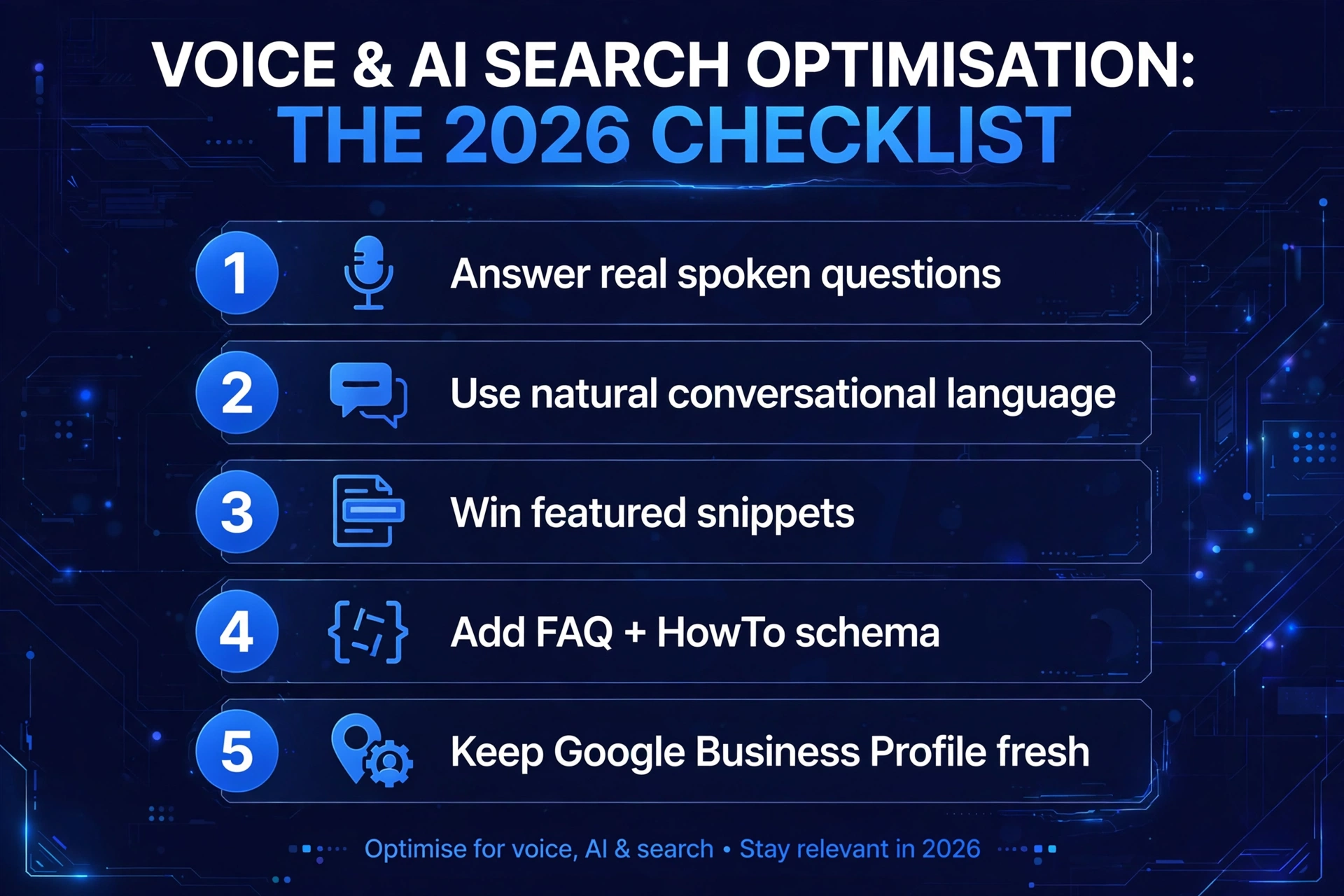
Step 1: Answer the questions your customers actually ask
Start with the questions people ask before they buy from you. Not the ones you wish they’d ask — the real ones, the ones your phone calls and emails are full of. “How much does it cost?” “How long will it take?” “Do you work with businesses like mine?”
Write each question out, exactly the way a customer would say it out loud. Then answer it on your website — directly, honestly, and in the first few sentences. Long, winding introductions bury the answer. An AI looking for a quotable answer will take the page that gives it first.
A dedicated FAQ page is worth its weight in gold here. One question per heading, one clear answer beneath it. It reads naturally to humans and it’s exactly the structure voice assistants love.
Step 2: Write the way people talk
Read your homepage out loud. Does it sound like a person explaining your business — or like a brochure from 2009? Most business websites fail this test badly.
Conversational copy wins voice search for a simple reason: the assistant is looking for an answer that sounds right when read aloud. Short sentences. Everyday words. Answers that start with the point instead of circling it for three paragraphs.
Try this: for every important question on your site, write a two-to-three sentence answer first — under fifty words — then expand with detail underneath. That opening block is your “spoken answer”. It works for humans too: busy visitors skim the short version and read on only if they’re interested.
Step 3: Win the featured snippet
When you search Google for a question, you’ll often see an answer box above the results — a paragraph, a list, or a table pulled from a single page. That’s the featured snippet, and it’s the single biggest building block of voice search answers. When someone asks their phone your question, the snippet is very often what gets read out.
Winning snippets isn’t mysterious. Structure your content the way snippets look:
- Definitions: a one-sentence definition of a term, right after the heading. (“An AI receptionist is a virtual assistant that answers your business calls, takes messages, and books appointments around the clock.”)
- Lists: numbered steps and bullet points. Google loves pulling these into answer boxes.
- Tables: comparisons in table form — features, prices ranges, options — are snippet gold.
- Direct answers: the question as a heading (H2 or H3), the answer in the first sentence beneath it.
You don’t have to win every snippet. But every question page on your site should be built to win its snippet.
Step 4: Add structured data — FAQ and HowTo schema
Schema is a way of labelling your content so search engines understand it precisely. Two types matter most for voice and AI search:
- FAQ schema marks up your question-and-answer pairs. It makes your FAQ page eligible for rich results and helps AI systems extract clean Q&A.
- HowTo schema marks up step-by-step instructions. If your business teaches anything — how to choose, how to prepare, how to maintain — this is how AI assistants find and quote your steps.
If your site runs on WordPress, plugins like Yoast SEO and Rank Math can add FAQ schema with a couple of clicks — no coding needed. The important thing is that the structured data matches the visible content on the page. Marking up answers that don’t exist on the page is a quick way to lose trust.
Step 5: Keep your Google Business Profile razor sharp
A huge share of voice searches are local: “Where’s the nearest…”, “Who’s open now?”, “Find me a…”. These answers come almost entirely from Google Business Profiles, not from websites.
If your profile is incomplete, outdated, or missing reviews, you’re invisible to every one of those searches. Check the basics: correct opening hours, accurate categories, a real description, current photos, and a steady flow of genuine reviews that you actually reply to. It’s free, it takes an afternoon to get right, and for local businesses it’s one of the highest-impact things on this entire list.
Step 6: Don’t forget the basics — speed, mobile and HTTPS
Voice and AI assistants favour websites that are fast, mobile-friendly and secure. That part hasn’t changed — it’s just more unforgiving now, because there’s no list of ten results for a slow site to hide in. One answer gets chosen. Make sure it’s yours.
If your site takes more than a few seconds to load on a phone, or throws security warnings, fix that before anything else on this list. Everything else is decoration on a broken foundation.
Frequently asked questions
Is voice search really important for small businesses?
For local businesses, yes — enormously. “Near me” and “best … near me” queries are overwhelmingly spoken, and they come from people ready to buy. If your competitors are optimised for voice and you aren’t, you’re handing them ready-made customers.
Do I need to rebuild my website for AI search?
No. AI search optimisation is mostly about content clarity and structure — clearer answers, better headings, schema markup, an up-to-date Google Business Profile. Most of it can be done on your existing site.
What’s the difference between SEO and AI search optimisation?
Traditional SEO helps you rank in a list of results. AI search optimisation helps you become the answer — the source an AI quotes. The foundations overlap (good content, technical health), but the emphasis shifts: quotable clarity beats keyword density.
How long does it take to see results?
Content changes can start showing in search results within weeks, but becoming a trusted, cited source is a longer game — think months of consistent, clear content. Anyone promising overnight results is selling you something.
Can Altus help with this?
Yes — it’s exactly what we do. We audit your site against voice and AI search, rewrite the pages that matter, add the structured data, and sort your Google Business Profile. Start with a free 15-minute website audit and we’ll show you exactly where you stand.
Is your website ready for voice and AI search? When a customer asks their phone for what you do, make sure the answer is you. Book a free 15-minute website audit and we’ll show you exactly what’s working, what’s missing, and what to fix first — no jargon, no obligation.